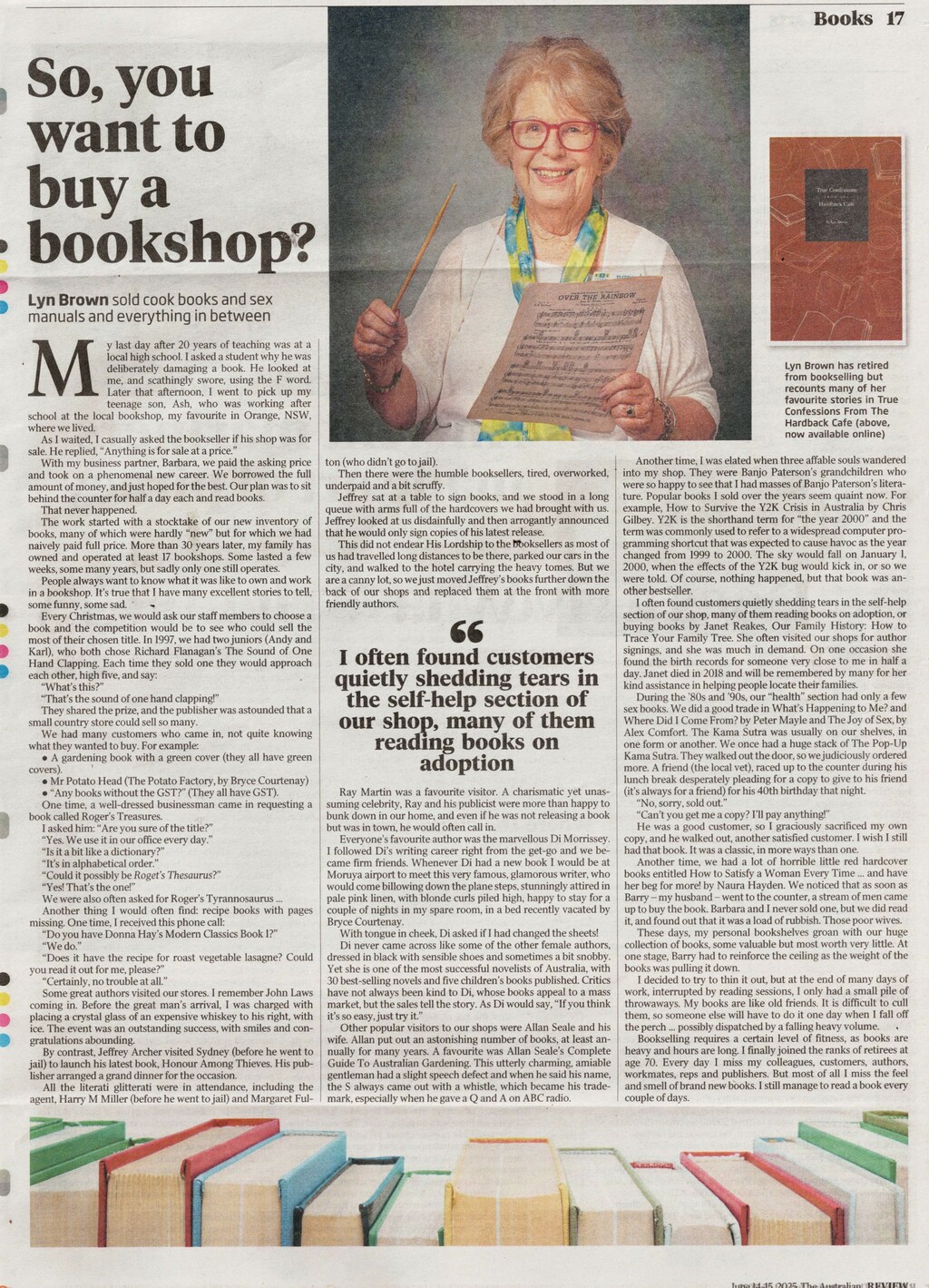
Lyn Brown sold cookbooks, sex manuals, and everything in between.
My last day after 20 years of teaching was at a local high school. I asked a student why he was deliberately damaging a book. He looked at me, scathingly swore, and used the F-word. Later that afternoon, I went to pick up my teenage son, Ash, who was working after school at the local bookshop—my favorite in Orange, NSW, where we lived.
As I waited, I casually asked the bookseller if his shop was for sale. He replied, "Anything is for sale at a price." With my business partner, Barbara, we paid the asking price and took on a phenomenal new career. We borrowed the full amount of money and just hoped for the best. Our plan was to sit behind the counter for half a day each and read books.
That never happened.
The work started with a stocktake of our new inventory of books, many of which were hardly "new" but for which we had naïvely paid full price. More than 30 years later, my family has owned and operated at least 17 bookshops. Some lasted a few weeks, some many years, but sadly, only one still operates.
People always want to know what it was like to own and work in a bookshop. It's true that I have many excellent stories to tell—some funny, some sad. Every Christmas, we would ask our staff members to choose a book, and the competition would be to see who could sell the most of their chosen title.
In 1997, we had two juniors, Andy and Karl, who both chose Richard Flanagan's The Sound of One Hand Clapping. Each time they sold one, they would approach each other, high-five, and say:
"What's this?"
"That's the sound of one hand clapping!"
They shared the prize, and the publisher was astounded that a small country store could sell so many.
We had many customers who came in, not quite knowing what they wanted to buy. For example:
One time, a well-dressed businessman came in requesting a book called Roger's Treasures.
I asked him, "Are you sure of the title?"
"Yes. We use it in our office every day."
"Is it a bit like a dictionary?"
"It's in alphabetical order."
"Could it possibly be Roget’s Thesaurus?"
"Yes! That's the one!"
We were also often asked for Roger’s Tyrannosaurus...
Another thing I would often find: recipe books with pages missing. One time, I received this phone call:
"Do you have Donna Hay's Modern Classics Book 1?"
"We do."
"Does it have the recipe for roast vegetable lasagne? Could you read it out for me, please?"
"Certainly, no trouble at all."
Some great authors visited our stores. I remember John Laws coming in. Before the great man’s arrival, I was charged with placing a crystal glass of expensive whiskey to his right, with ice. The event was an outstanding success, with smiles and congratulations abounding.
By contrast, Jeffrey Archer visited Sydney (before he went to jail) to launch his latest book, Honour Among Thieves. His publisher arranged a grand dinner for the occasion. All the literati glitterati were in attendance, including the agent Harry M. Miller (before he went to jail) and Margaret Fulton (who didn’t go to jail).
Then there were the humble booksellers—tired, overworked, underpaid, and a bit scruffy.
Jeffrey sat at a table to sign books, and we stood in a long queue with arms full of hardcovers we had brought with us. He looked at us disdainfully and then arrogantly announced that he would only sign copies of his latest release. This did not endear His Lordship to the booksellers, as most of us had traveled long distances to be there, parked our cars in the city, and walked to the hotel carrying the heavy tomes. But we are a canny lot, so we just moved Jeffrey’s books further down the back of our shops and replaced them at the front with more friendly authors.
I often found customers quietly shedding tears in the self-help section of our shop, many of them reading books on adoption.
Ray Martin was a favorite visitor. A charismatic yet unassuming celebrity, Ray and his publicist were more than happy to bunk down in our home. Even if he was not releasing a book but was in town, he would often call in.
Everyone’s favorite author was the marvelous Di Morrissey. I followed Di’s writing career right from the get-go, and we became firm friends. Whenever Di had a new book, I would be at Moruya airport to meet this very famous, glamorous writer, who would come billowing down the plane steps, stunningly attired in pale pink linen, with blonde curls piled high—happy to stay for a couple of nights in my spare room, in a bed recently vacated by Bryce Courtenay.
With tongue in cheek, Di asked if I had changed the sheets!
Di never came across like some of the other female authors, dressed in black with sensible shoes and sometimes a bit snobby. Yet she is one of the most successful novelists in Australia, with 30 best-selling novels and five children’s books published. Critics have not always been kind to Di, whose books appeal to a mass market, but the sales tell the story. As Di would say, "If you think it’s so easy, just try it."